
Practical Challenges Associated with A2L Packaged Direct Expansion Design

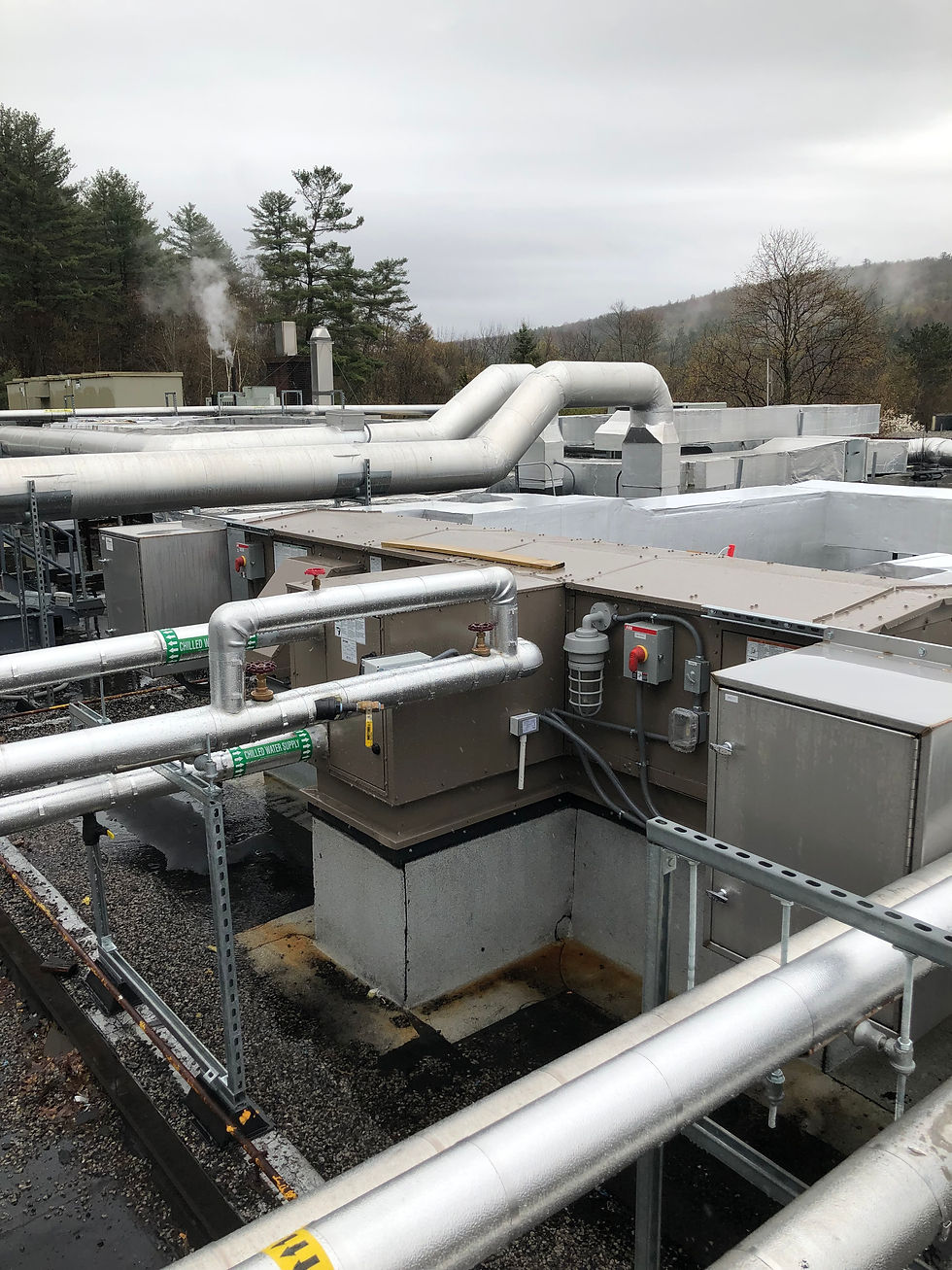
Recent new federal legislation has required all commercial HVAC refrigerant-based equipment to adhere to new rules focused on reducing the global warming impact refrigerants have on the environment. The legislation sets a maximum 'Global Warming Potential' for any refrigerant implemented in commercial HVAC equipment which, has forced manufacturers within the industry to implement new designs utilizing compliant refrigerants.
These refrigerants, known collectively as the “A2L” category, are categorized by the American Society for Heating Refrigeration and Air-Conditioning Engineers (ASHRAE) as slightly flammable – a new, industry-wide, design challenge for the future. This blog explores some of the technical design challenges the manufacturers in the industry are facing, and associated solutions implemented thus far as this equipment propagates throughout the US market.
Flammability Changes the Risk Model
A2L refrigerants are classified as such because they’re mildly flammable but low-toxicity. That means typical leak scenarios that were once treated primarily as pressure and charge issues now require assessment for ignition sources, ventilation, and gas-accumulation risk. Packaged DX units — especially rooftop or make-up-air arrangements with burners or electrical cabinets — must be designed to prevent refrigerant accumulation in compartments where an ignition source could exist. Real-world guidance emphasizes zoning, separation from burners, and elimination or isolation of potential ignition sources.
Codes and Standards Are Evolving
Standards bodies (ASHRAE, AHRI) and the model codes have updated guidance for A2L use, but state level adoption and local amendments vary widely. That creates uncertainty for specifying a packaged AHU that must meet different local interpretations of ASHRAE 15 & 34, International Code Council, and utility or jurisdictional requirements. A variety of these codes impact architectural requirements as well. The practical effect: a design that’s acceptable in one city may require additional safeguards, relocations, or even a different refrigerant choice in another. Early coordination with code officials and specifying flexible, code-adaptive design strategies is essential.
HVAC/Mechanical Room HVAC System render Blueprint
Mechanical Layout and Charge Limits
Because A2Ls are flammable, allowable refrigerant charge limits in occupied spaces or enclosed machinery rooms are tighter than for A1 refrigerants. For packaged DX AHUs that contain coils, piping, and compressors, this means reconsidering where components are located within the equipment (e.g., placing compressors in outdoor or ventilated enclosures), minimizing internal piping lengths, implementing intermediate isolation solenoids, and using smaller-charge circuits or secondary loops where feasible. Manufacturers often must re-engineer coil assemblies, brazing practices, and service access to keep charges below thresholds and to make leak isolation practical.
Electrical and Ignition Control Design
A2L risk isn’t only about the refrigerant — it’s about interaction with electrical systems. Switchgear arcing, motors, control relays, pilot lights, and gas burners are all potential ignition sources. Packaged units need careful segregation of refrigerant cavities from electrical compartments, use of intrinsically safe control methods where possible, and interlocks that shut down compressors and isolated circuits if a leak is detected. Coordination between mechanical, controls, and electrical disciplines in equipment specification becomes a hard requirement rather than a nice-to-have.
Vent in mechanical room Electric panels
Leak Detection, Ventilation and Safety Systems
Because of the mild flammability, continuous refrigerant detection becomes a mainstream design element for many A2L applications. Detection thresholds, sensor placement, and response logic must be engineered so that a detected leak triggers safe shutdown, ventilation activation, and alarm sequences — without creating nuisance trips. Additionally, ventilation paths and dilution strategies must be demonstrated to prevent gas pockets in low-flow areas of the AHU or housings. Expect to add labeled relief/vent paths, forced dilution strategies, and sensor redundancy for critical installations.
Serviceability and Technician Training
Transitioning to A2L changes service procedures: brazing techniques, leak testing (nitrogen vs. alternative methods), evacuation, charging, and hot-work practices all must be redefined. Technicians need training and tooling changes (e.g., brazing procedures that minimize in-place charge, leak-tight flareless fittings, refrigerant-rated PPE). Documenting safe servicing procedures and ensuring contractor capability are as important as the design itself — poor field practices can undo even the best engineering.
HVAC System training HVAC System pressure test
Testing, Validation, and Manufacturer Responsibility
Manufacturers of packaged DX AHUs must validate designs for A2L use: pressure testing, leak-path analysis, compressor and control system compatibility, and whole-unit safety testing under realistic fault scenarios. Because codes and marketplace expectations are moving, manufacturers should build flexibility into options (e.g., factory-installed detection kits, secondary loop options) so specifiers can tailor units to local code or owner risk tolerance.
Bottom Line
A2L refrigerants are not a drop-in swap for legacy A1 blends in packaged DX AHUs. They require a systems approach — rethink layout, electrical segregation, leak detection, ventilation strategy, and service practices — and early conversations with manufacturers and code officials. When done well, the outcome is lower GWP, efficient equipment that meets safety requirements; when overlooked, the change introduces risk and costly retrofits. For any rooftop/packaged DX spec, treat A2L as a design driver, not a footnote.

Written by:
Derek Day
Associate, Mechanical Project Leader


Comments