
Meeting IECC Hot Water Distribution Requirements Using Localized Recirculation Strategies

Updated: Apr 30
Recent International Energy Conservation Code (IECC) adoption and enforcement has brought increased attention to domestic hot water distribution requirements—particularly for public lavatories. One of the most impactful provisions limits the allowable volume of un-recirculated hot water piping, which for typical pipe sizes translate to approximately 2 feet of developed length between the recirculated system and the lavatory. This requirement exceeds most local and national codes for recirc requirements. While the intent is to reduce water waste and improve energy efficiency, this requirement has meaningful implications for system layout, coordination, and overall design approach.
Understanding the Requirement
The IECC limits the volume of water contained in piping between the hot water source (or recirculated main) and the lavatory. For public lavatories, this allowable volume is extremely small—effectively requiring that hot water be maintained within close proximity to the fixture.
For standard 1/2” and 3/4” piping, this results in a maximum developed length of approximately 2 feet of un-recirculated piping. Traditional branch piping approaches, where multiple fixtures are served from a single branch off a recirculated main, often do not meet this requirement.
The allowable piping lengths vary based on pipe diameter, as defined by the IECC, and are summarized in Table C404.5.1 below

Impacts on System Design
This limitation introduces several challenges for plumbing system design:
Expanded recirculation systems: Recirculated piping must be extended closer to each fixture
Increased coordination: Routing additional piping within ceiling spaces requires careful coordination with other trades
Higher installation costs: Additional piping, valves, and balancing components increase project cost
Reduced flexibility: Standard “rule-of-thumb” layouts may no longer be viable
As a result, what was previously considered a straightforward distribution system now requires a more deliberate and coordinated design approach.
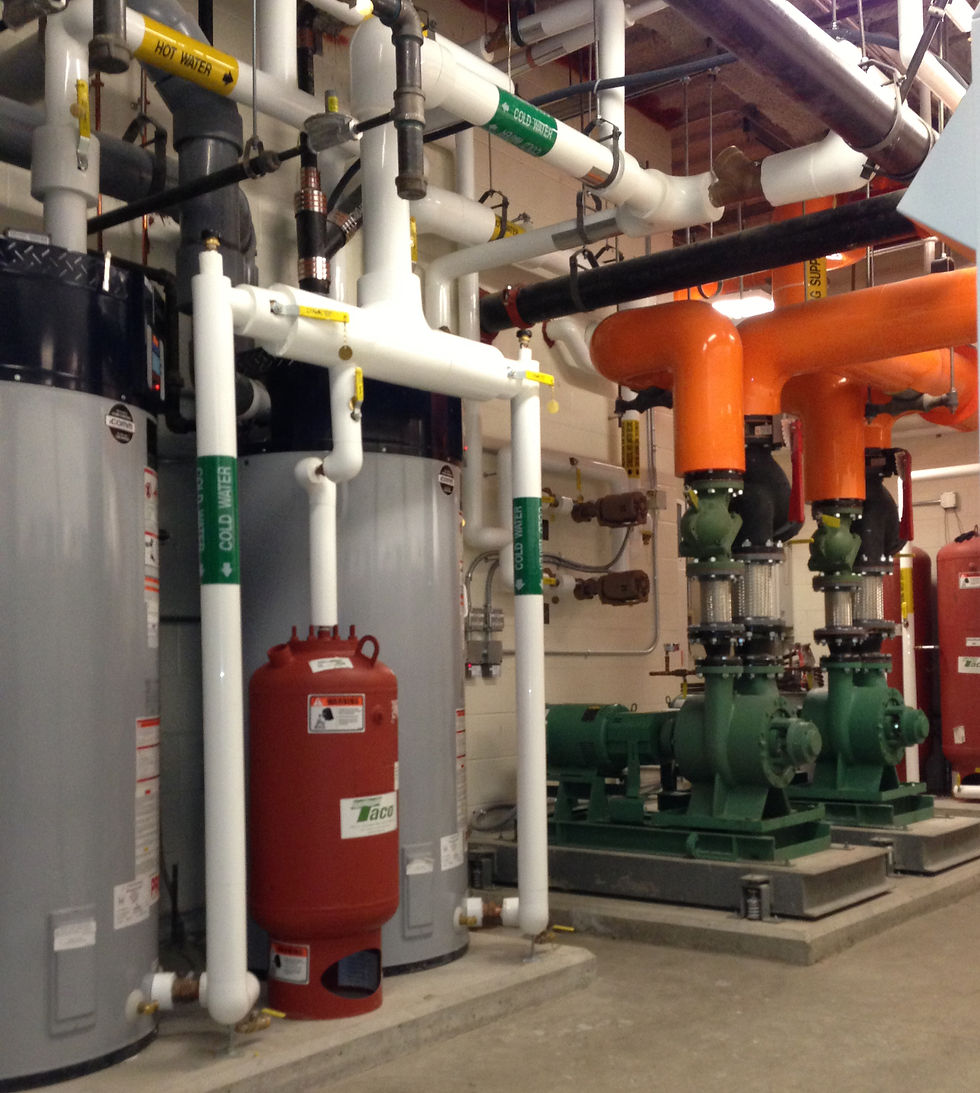
Exterior shot of mechanical and plumbing systems on roof Shot of a mechanical room Render for MEP Systems
Localized Recirculation as a Solution
To meet the IECC requirement while maintaining an efficient system, designers can implement localized recirculation strategies. One effective approach is the use of flow management devices, such as Kemper flow splitter valves.
These devices allow the system to:
Maintain continuous recirculation within the main loop
Deliver hot water to fixtures while keeping the recirculation path active
Eliminate long dead legs of stagnant water
Improve system balance and performance
By utilizing flow splitter valves, engineers can bring recirculated hot water within the required distance of each lavatory without introducing excessive return piping or overly complex layouts.
Design and Coordination Considerations
While localized recirculation provides a viable solution, proper implementation is key:

Strategic placement: Devices must be located to ensure compliance with the 2-foot requirement
System balancing: Proper commissioning is necessary to maintain consistent flow throughout the loop
Maintenance access: Valves should be installed in accessible locations
Owner coordination: Early discussions are important to align on system complexity, cost, and long-term maintenance
Incorporating these considerations early in the design process helps avoid costly revisions during construction.
Conclusion

As newer IECC requirements continue to shape plumbing system design, engineers must adapt to increasingly stringent performance criteria. The limitation on un-recirculated hot water piping to public lavatories is a clear example of how energy and water conservation goals are influencing system layout.
By leveraging localized recirculation strategies, such as the use of flow splitter valves, design teams can meet code requirements while maintaining efficient, reliable, and maintainable systems. Early planning and coordination remain critical to successfully implementing these solutions in both new construction and renovation projects.

Written by:
Liam Mone



Comments